Understanding the Growing Threat of Financial Fraud.
Financial fraud has become one of the fastest-growing crimes affecting individuals, businesses, professionals, and organizations worldwide. Every day, unsuspecting victims lose substantial amounts of money to fraudsters who impersonate legitimate institutions, government agencies, financial service providers, employers, charities, investment companies, and other reputable organizations.
These criminals often use sophisticated tactics to gain trust, including fake emails, forged documents, cloned websites, fraudulent contracts, counterfeit identification documents, social media impersonation, and deceptive telephone calls. Their objective is simple: convince victims to transfer money, disclose sensitive information, or grant unauthorized access to financial resources.
For many victims, the emotional impact can be as devastating as the financial loss. Feelings of embarrassment, anxiety, frustration, and helplessness frequently accompany such incidents. However, victims should understand that professional investigative assistance may help identify critical evidence, trace fraudulent activities, and support lawful recovery efforts.
How Professional Financial Fraud Investigations Help Victims.
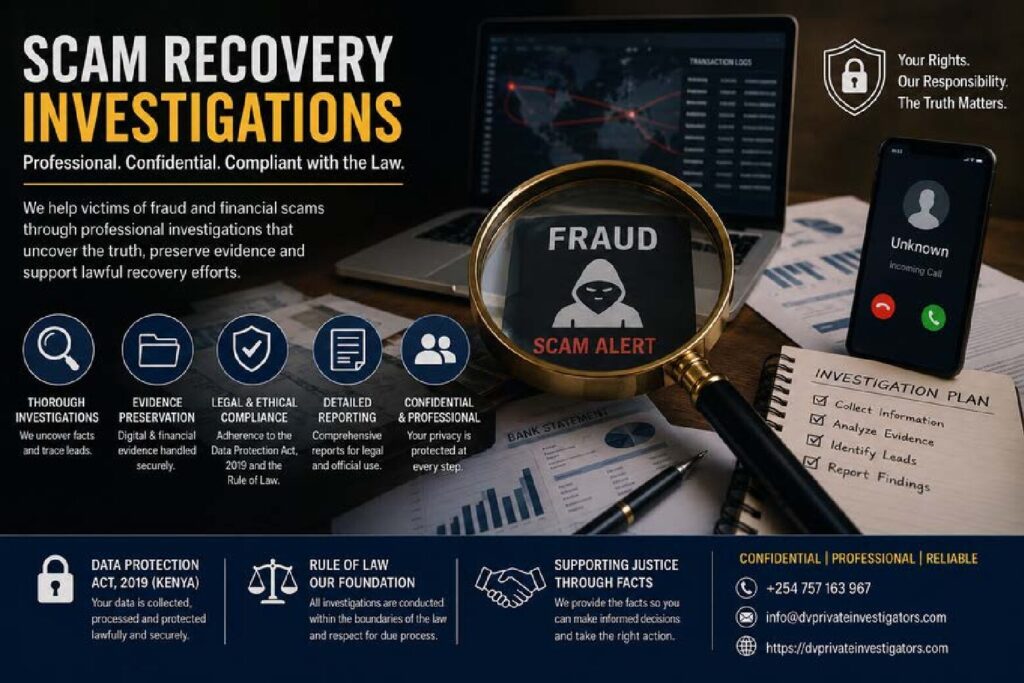
Specialized financial fraud investigators provide comprehensive investigative services designed to uncover the facts behind fraudulent transactions and identify those responsible for financial deception.
Investigative services may include:
1. Fraud Assessment and Case Evaluation.
Every case begins with a detailed review of the circumstances surrounding the fraud. Investigators examine:
- Communication records
- Payment confirmations
- Banking information
- Contracts and agreements
- Electronic correspondence
- Transaction histories
- Digital evidence.
This assessment helps determine how the fraud occurred and identifies potential investigative leads.
2. Digital Evidence Collection.
Modern fraud schemes often leave digital footprints. Professional investigators gather and analyze evidence from:
- Emails
- Mobile communications
- Social media interactions
- Websites
- IP addresses
- Electronic payment systems
- Online transaction records.
Such evidence can prove essential in identifying suspects and supporting legal proceedings.
3. Tracing Fraudulent Transactions.
Where legally permissible, investigators assist in tracing the movement of funds through available records and lawful investigative techniques. This process helps establish transaction patterns and may reveal connections between multiple fraudulent activities.
4. Impersonation and Identity Fraud Investigations.
Many scams involve criminals falsely claiming to represent:
- Government agencies
- International organizations
- Financial institutions
- Employers
- Recruitment agencies
- Educational institutions
- Investment firms
- Charitable organizations.
Investigators verify the legitimacy of the entities involved and uncover evidence of impersonation or identity misuse.
5. Preparation of Investigation Reports.
Professional investigations result in comprehensive reports that can assist victims when reporting matters to:
- Law enforcement agencies
- Regulatory authorities
- Financial institutions
- Legal representatives
- Insurance providers.
Why Victims Should Report Fraud Promptly.
Time is often a critical factor in financial fraud investigations.
Prompt reporting may help:
- Preserve valuable evidence
- Document communication records
- Support lawful intervention efforts
- Identify additional victims
- Prevent further financial losses
- Strengthen legal and regulatory actions.
Delays can result in the loss of critical information that may be important during investigations.
Commitment to Legal Compliance and Ethical Investigations.
Professional financial fraud investigations must always operate within the framework of applicable laws and regulations.
Responsible investigators:
- Respect privacy rights
- Maintain confidentiality
- Follow lawful investigative procedures
- Protect client information
- Preserve evidence integrity
- Avoid unlawful surveillance or unauthorized access
- Cooperate with relevant authorities where appropriate.
All investigative activities should comply with applicable laws governing private investigations, data protection, evidence handling, and financial crime reporting.
Creating a Safe Environment for Victims.
Many victims hesitate to seek help because they fear judgment, embarrassment, or exposure. A professional investigative service recognizes that anyone can become a victim of sophisticated fraud.
Clients can expect:
Confidentiality.
Information provided by clients is treated with the highest degree of discretion and professionalism.
Respect and Understanding.
Victims are treated with dignity and without judgment regardless of the circumstances surrounding the fraud.
Professional Guidance.
Clients receive practical information regarding available investigative options and reporting procedures.
Objective Fact-Finding.
Investigations focus on evidence, facts, and lawful procedures rather than speculation or assumptions.
Common Warning Signs of Imposter Scams.
Individuals should remain alert when they encounter:
- Requests for urgent payments
- Pressure to act immediately
- Promises of unusually high returns
- Unexpected requests for personal information
- Demands for secrecy
- Suspicious website addresses
- Unverified employment offers
- Requests for advance fees
- Unusual banking instructions
- Communications from unofficial channels.
Verifying information directly with legitimate organizations before making payments can significantly reduce the risk of becoming a victim.
Protecting Yourself Against Future Fraud.
To minimize financial risks:
- Verify identities independently.
- Confirm payment instructions through official channels.
- Avoid sharing sensitive information unnecessarily.
- Keep records of all transactions.
- Use secure communication methods.
- Report suspicious activity immediately.
- Conduct due diligence before making significant financial commitments.
Conclusion.
Financial fraud continues to evolve, but victims are not without options. Professional investigative services play a vital role in uncovering fraudulent schemes, preserving evidence, assisting lawful recovery efforts, and supporting victims throughout the process.
By combining thorough investigations, legal compliance, confidentiality, and professional expertise, investigative specialists help restore confidence and provide a pathway toward accountability. Victims should never suffer in silence. Reporting suspected fraud promptly can be the first step toward protecting financial interests and preventing others from becoming victims of similar schemes.